September 21, 2026

 Written by Mariam
If you have used an Enigma2 satellite receiver or searched for satellite TV receiver technology, you have probably come across the term CCcam.
But what exactly is CCcam? Is it software, a protocol, a receiver feature, or a type of satellite service?
The answer is a little more complicated than it first appears.
CCcam is associated with a software and communication protocol used in satellite receiver environments. It became particularly well known in the Enigma2 ecosystem and has remained a familiar term among users of receivers such as Vu+, Dreambox and other Linux-based satellite boxes.
This beginner-friendly guide explains what CCcam is, how it relates to Enigma2, what role it plays in a satellite receiver, how it differs from OSCam, and what users should understand before working with a CCcam-based setup.
Important: This article is intended for educational and receiver-technology purposes. The use of any conditional-access or card-sharing technology should comply with applicable laws, broadcaster terms and subscription rights.
CCcam is a software and protocol technology associated with conditional-access communication in satellite receiver environments.
The name is commonly used in two related contexts:
The protocol defines how compatible software components communicate within a supported receiver environment.
CCcam became especially well known through its use with Linux-based satellite receivers and the wider Enigma2 ecosystem.
It is important, however, not to confuse CCcam with a satellite channel list, an Enigma2 operating system, or a satellite receiver itself.
These are separate components that can exist together in the same receiver environment.
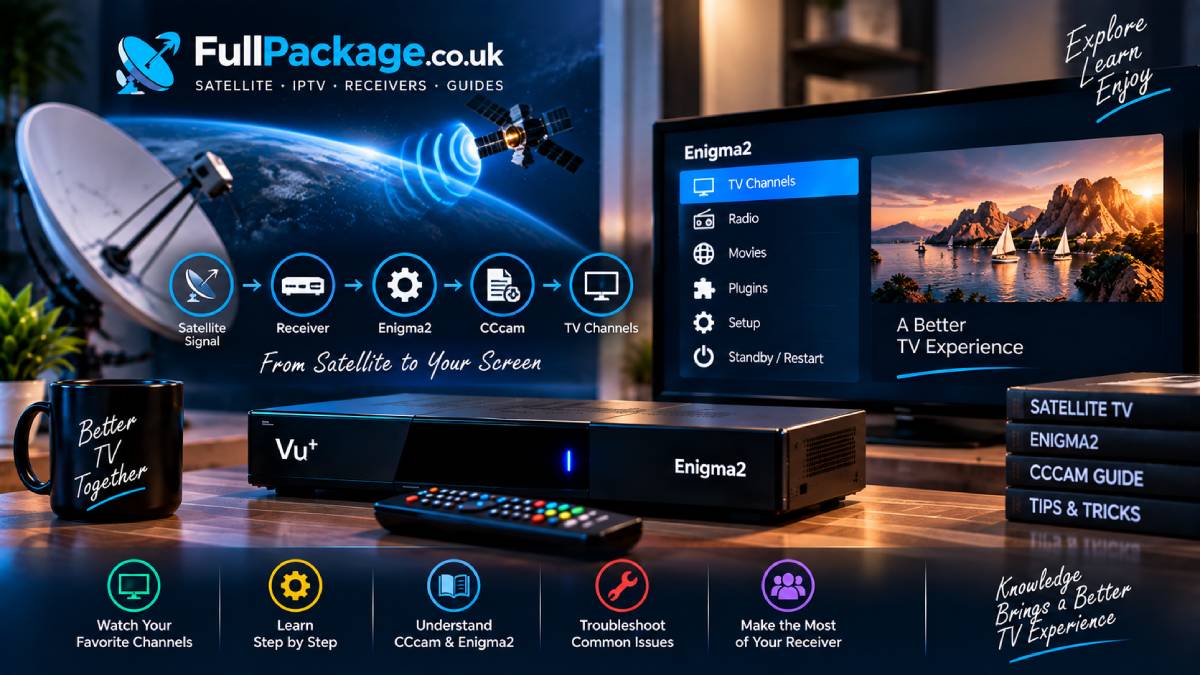
Enigma2 is a Linux-based software platform used by many satellite receivers.
CCcam is not Enigma2 itself.
Instead, CCcam can operate as a softcam component within a compatible Enigma2 environment.
A simplified view looks like this:
Satellite Dish → Satellite Signal → Tuner → Enigma2 → Softcam Environment → Authorized Conditional-Access Service
The exact architecture depends on the receiver, Enigma2 image and installed software.
Popular Enigma2 ecosystems include receivers from brands such as:
Compatibility should always be checked for the specific receiver and image rather than assuming that every Enigma2 box supports every softcam in exactly the same way.
No.
This is one of the most common misunderstandings among beginners.
A satellite receiver is the physical device that receives and processes satellite broadcasts.
Enigma2 is the software environment running on many Linux-based receivers.
CCcam is a software/protocol component that can operate within a compatible receiver environment.
Think of them as different layers:
| Component | Role |
|---|---|
| Satellite Dish | Receives the satellite signal |
| LNB | Converts the received signal |
| Tuner | Processes the satellite frequency |
| Receiver | Runs the hardware and software |
| Enigma2 | Provides the receiver software environment |
| Softcam | Handles supported conditional-access functions |
| CCcam | A softcam/protocol technology |
Understanding these layers makes troubleshooting much easier.
For example, a No Signal message is normally investigated at the dish, LNB, cable or tuner level—not by immediately changing CCcam.
At a high level, CCcam provides a communication framework for supported conditional-access operations between compatible components.
This is why CCcam is usually discussed together with:
The exact functionality depends on the software environment and how the receiver is configured.
For legitimate use, the receiver and service must have the appropriate authorization to access protected content.
CCcam became widely known because it was relatively straightforward compared with more complex conditional-access software environments.
Its historical popularity was supported by several factors:
CCcam became strongly associated with Linux-based satellite receivers, particularly the Enigma2 ecosystem.
Compared with more modular systems, traditional CCcam environments were often easier for users to understand.
CCcam has been discussed extensively in satellite receiver communities for many years.
Many older receiver installations were built around CCcam, meaning that the technology remains relevant when maintaining existing equipment.
Even when newer alternatives are available, experienced satellite receiver users may still encounter CCcam when working with older configurations.
To understand CCcam properly, it helps to understand the idea of conditional access.
Satellite broadcasters can use conditional-access systems to restrict certain broadcasts to authorized subscribers.
A receiver may therefore need the appropriate authorization and compatible conditional-access technology to access protected content.
CCcam became associated with communication between compatible conditional-access components.
However, CCcam itself should not be understood as a subscription to a television package.
A receiver, satellite signal, subscription authorization and software environment are separate parts of the overall system.
The term CCcam server generally refers to the server side of a CCcam-based communication environment.
In a legitimate setup, the server-side infrastructure can communicate with compatible clients according to the supported protocol and authorization model.
The term is often used online in connection with satellite TV services, but users should be careful because not every service advertised as a “CCcam server” is necessarily authorized.
When evaluating a service, consider:
For more information about evaluating a service, see our CCcam Server Test guide.
A CCcam client is the client side of a compatible CCcam communication environment.
In simple terms, the client is the receiver-side component that communicates with a compatible server environment.
This client/server terminology is similar to other network technologies:
Client → requests or communicates
Server → provides the corresponding service
The actual implementation depends on the software and authorization environment.
Enigma2 is one of the environments most strongly associated with CCcam.
A typical Enigma2 receiver may contain several software layers:
This means that a CCcam problem is not necessarily a CCcam problem.
For example:
No satellite signal → check tuner and reception.
No internet connection → check network configuration.
Softcam not running → check the receiver software environment.
Only certain channels unavailable → check channel and service compatibility.
This layered approach is particularly useful when troubleshooting.
You can read our complete CCcam Troubleshooting guide for a step-by-step diagnostic approach.
CCcam does not create satellite channels.
The receiver still needs the correct satellite configuration and channel information.
A channel list contains information that helps the receiver identify and organize available services.
This can include information associated with:
If channel information changes, a receiver may need a channel scan or an updated channel list.
You can learn more in our Satellite Channel List guide.
This distinction is important because users sometimes assume that changing CCcam will solve a channel-list problem.
It will not.
One of the most common questions is whether CCcam and OSCam are the same thing.
They are not.
CCcam is associated with its own software and protocol environment.
OSCam is a separate open-source project with a broader modular architecture and support for multiple protocols, including CCcam. OSCam’s current documentation explicitly lists CCcam among its supported protocols.
This means OSCam can sometimes communicate using the CCcam protocol without being the same software.
| CCcam | OSCam |
|---|---|
| Long-established technology | Open-source project |
| Strong legacy presence | Modular architecture |
| Simpler traditional model | More configuration options |
| Associated mainly with CCcam protocol | Supports multiple protocols |
| Common in older installations | Used in more flexible environments |
For a detailed comparison, see our article:
CCcam vs OSCam: Understanding the Differences on Enigma2
Yes, CCcam is still encountered in existing satellite receiver environments.
However, there is an important distinction between being widely known and being actively developed.
CCcam has a long history in the satellite receiver community, while OSCam continues as an open-source project with ongoing development and documentation. Current OSCam documentation still lists CCcam protocol support.
This means users maintaining an older receiver may still encounter CCcam frequently, while someone building or modernizing a receiver environment may also consider other softcam technologies.
The best choice depends on:
There is no single compatibility rule that applies to every Enigma2 receiver.
Compatibility can depend on:
Different receivers use different processors and architectures.
OpenATV, OpenPLi, VTi and other images can have different software repositories, menus and management systems.
A software build must be compatible with the receiver architecture and operating environment.
An older receiver may depend on legacy components that are not available in newer environments.
Some receiver software environments require network communication, so network availability can become part of the overall setup.
Always verify compatibility before installing or replacing receiver software.
Beginners often assume that every CCcam-related issue has the same cause.
In reality, problems can occur at several levels.
Usually investigate:
Investigate:
Investigate:
Investigate:
Investigate:
This is why our CCcam Troubleshooting article recommends diagnosing the receiver layer by layer instead of immediately reinstalling everything.
If you are new to satellite receiver technology, there are several things worth understanding before changing your receiver configuration.
It is a software/protocol component, not a hardware device.
Enigma2 provides the operating environment in which compatible receiver software can run.
A satellite signal problem cannot normally be solved by changing network software.
Always check the receiver model and installed Enigma2 image.
If you use a CCcam-related service, make sure it is lawful and appropriately authorized in your jurisdiction.
Before changing major receiver software or configurations, keep a backup of important settings and channel lists.
The answer depends on how the technology is used and where you are located.
CCcam as a technology should not be confused with the legality of every service advertised around it.
Authorized conditional-access systems and legitimate receiver technologies can be used within applicable licensing and subscription arrangements.
On the other hand, unauthorized redistribution or access to protected broadcasts can violate laws, licensing agreements or broadcaster terms.
Therefore, before using any CCcam-related service, verify that it is authorized for the content and jurisdiction involved.
The term Free CCcam is widely used online, but the word “free” does not automatically mean that a service is legitimate or safe.
Free offers can vary significantly in:
If a provider offers a legitimate trial, it is still sensible to evaluate the receiver compatibility and service stability before making a longer-term commitment.
You can visit the Free CCcam & OSCam 24-Hour Trial page to learn about the available trial option.
A modern Enigma2 receiver can contain several components working together:
Satellite Dish
↓
LNB and Tuner
↓
Satellite Signal
↓
Enigma2 Operating Environment
↓
Channel Database
↓
Softcam Environment
↓
Authorized Conditional-Access Service
Each layer has a different job.
Understanding this structure makes it easier to troubleshoot problems and avoid changing the wrong component.
CCcam is the name associated with a well-known satellite receiver software and communication protocol. It became particularly common in Linux-based and Enigma2 receiver environments.
The term is used for both the CCcam software and the associated communication protocol. Context determines which one is being discussed.
No. Enigma2 is the receiver’s software environment, while CCcam is a separate softcam/protocol technology that can operate within compatible environments.
CCcam has historically been used extensively with Enigma2 receivers, but compatibility depends on the receiver model, image and software environment.
CCcam is a long-established software/protocol technology, while OSCam is a separate open-source, modular project that supports multiple protocols, including CCcam.
No. “No Signal” normally requires checking the satellite dish, LNB, cable, tuner and satellite configuration.
CCcam was developed for use in satellite receiver environments and became particularly well known among users of Linux-based and Enigma2 receivers.
It remains relevant when discussing existing and legacy satellite receiver installations. However, users should also consider current software maintenance and compatibility when building a new receiver environment.
Not necessarily. Compatibility depends on the receiver hardware, Enigma2 image, available software and the specific authorized service.
So, what is CCcam?
CCcam is a long-established software and communication technology associated with satellite receiver environments, particularly Enigma2.
It is not a satellite receiver, not a channel list and not a television subscription itself.
Understanding the difference between the receiver, Enigma2, tuner, network, softcam and conditional-access service is essential for anyone working with satellite receiver technology.
CCcam also remains an important part of the history and legacy of Enigma2, while projects such as OSCam provide a more modular and actively maintained alternative for compatible environments.
If you are learning about CCcam for the first time, start with the basics, verify receiver compatibility, keep your software backed up and make sure any service you use is properly authorized.

Helping you stay connected with the best IPTV experience. FullPackage IPTV offers premium live TV, sports, movies, and international channels in HD & 4K. Enjoy seamless streaming anytime, anywhere!
© Fullpackage is Proudly Owned by fullpackage.co.uk