September 18, 2026

 Written by Mariam
When choosing a softcam environment for an Enigma2 satellite receiver, two names appear frequently: CCcam and OSCam.
Although they are often discussed together, they are not identical solutions. They differ in architecture, configuration, flexibility, monitoring capabilities, and ongoing development.
For Enigma2 users, understanding these differences can make it easier to identify which technology fits a particular receiver environment and troubleshooting requirement.
This guide explains CCcam vs OSCam from a technical and practical perspective without focusing on unauthorized access or encrypted-channel bypassing.
CCcam and OSCam are software solutions used within satellite receiver environments to handle conditional-access-related communication.
CCcam is the name associated with both the software and its protocol. It became widely used in satellite receiver communities because of its relatively simple configuration and broad historical compatibility.
OSCam, or Open Source Conditional Access Module, is a more modular and actively maintained project. Its documentation shows support for multiple protocols, including the CCcam protocol, which means OSCam can interact with CCcam-based environments without being identical to CCcam itself.
This distinction is important: OSCam can support CCcam protocol communication, but OSCam and CCcam are separate software projects.
| Feature | CCcam | OSCam |
|---|---|---|
| Project type | Proprietary/closed | Open-source |
| Configuration | Relatively simple | More modular |
| Protocol support | Primarily associated with CCcam | Multiple protocols |
| Monitoring | More limited | More detailed |
| Flexibility | Lower | Higher |
| Configuration files | Simpler structure | Multiple configuration components |
| Enigma2 use | Long-established | Widely used |
| Development status | Legacy technology | Actively maintained project |
| Best suited to | Existing compatible environments | Flexible and evolving environments |
The exact behavior and available features can vary depending on the Enigma2 image, receiver and software build.
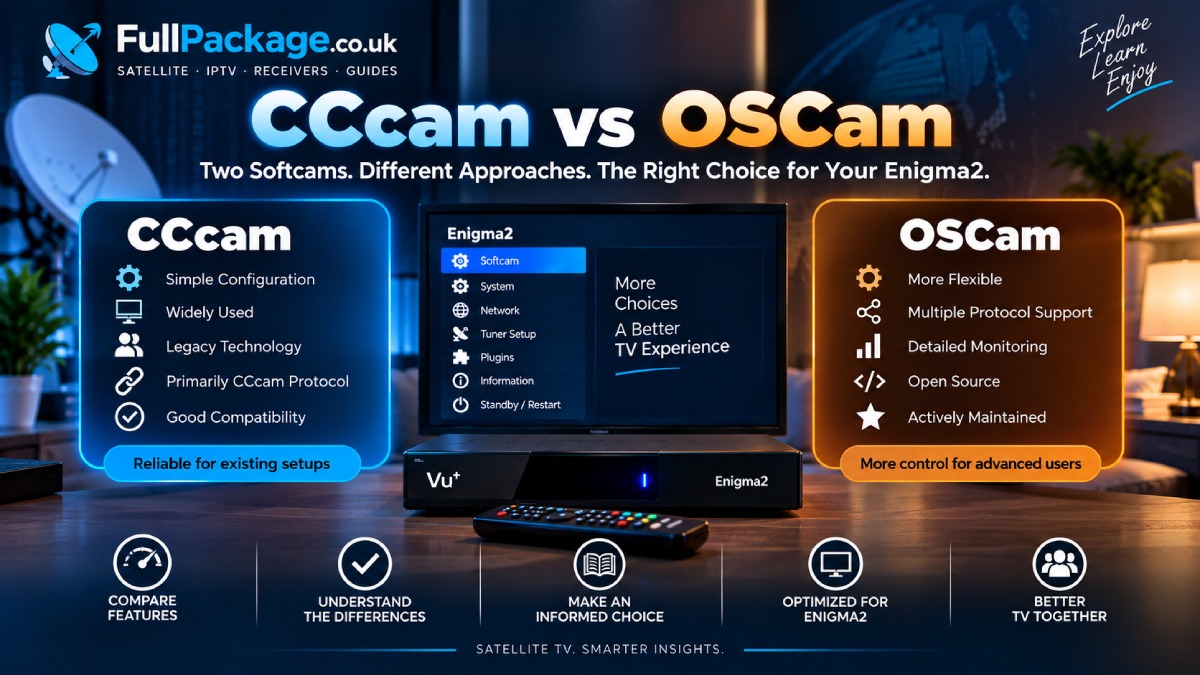
One reason CCcam became popular was its relatively straightforward approach.
For users working with an older or already-established receiver environment, this simplicity can be useful.
CCcam is particularly associated with:
However, simplicity can also mean fewer configuration and monitoring options compared with a more modular solution.
CCcam is now considered legacy technology.
Current community sources describe CCcam development as largely stalled, while OSCam continues to receive community-maintained development. This matters when considering compatibility with newer Enigma2 images and modern receiver environments.
For this reason, users maintaining an older receiver may view CCcam differently from someone building a new setup.
OSCam takes a different approach.
Instead of focusing on a single protocol environment, OSCam provides a modular architecture capable of supporting several protocols and reader types.
The project’s documentation contains dedicated configuration components and explicitly documents CCcam protocol support.
This makes OSCam attractive when a receiver environment requires:
The additional flexibility comes with a trade-off: OSCam can be more complicated to understand and configure than a simpler legacy softcam.
One of the clearest differences is configuration.
CCcam is traditionally associated with a simpler configuration structure.
This can make it easier for someone who is maintaining an existing compatible installation and does not need advanced configuration options.
OSCam uses a more modular configuration architecture.
Its documentation includes separate configuration areas for different functions and protocols. This gives administrators considerably more control but also means there is more to learn.
In practical terms:
CCcam → simpler structure
OSCam → greater control and flexibility
That does not automatically make one universally better. The appropriate choice depends on the receiver, image, existing environment and technical requirements.
This is one of the strongest technical differences.
CCcam is primarily associated with the CCcam ecosystem.
OSCam, on the other hand, supports multiple protocols and can also communicate using the CCcam protocol.
The OSCam documentation explicitly includes CCcam-related configuration and reader support.
This means OSCam can sometimes serve as a more flexible software layer when an Enigma2 installation needs to work with different technologies.
Imagine an Enigma2 environment that changes over time.
A solution that supports only one protocol may become restrictive if the rest of the environment changes.
A modular system can provide more options for adapting the receiver without completely changing the software architecture.
Monitoring is another important difference between CCcam and OSCam.
With a basic CCcam environment, troubleshooting can be relatively limited.
OSCam provides more detailed logging and monitoring options, which can help experienced users identify where a problem is occurring.
This becomes especially useful when diagnosing:
For users who have already read our CCcam Troubleshooting guide, this distinction is important.
A more detailed diagnostic environment can make it easier to determine whether the problem originates from the receiver, network, software or service environment.
Both technologies can appear in Enigma2 receiver environments, but their roles can differ.
Enigma2 itself is the receiver’s operating environment. CCcam or OSCam operates as an additional software component that interacts with the receiver’s conditional-access and softcam framework.
The exact menus and management options depend on the Enigma2 image.
For example, OpenATV, OpenPLi and VTi can have different softcam management interfaces.
Therefore, a guide written for one image should not automatically be treated as a universal instruction set for every Enigma2 receiver.
Compatibility is increasingly important when comparing legacy and actively maintained software.
An older softcam may continue working perfectly on a particular receiver, but that does not necessarily mean it will remain compatible with every future image or software environment.
Current 2026 community analysis describes CCcam as largely legacy software, while OSCam continues to receive development and is generally more adaptable to newer environments.
This does not mean that every OSCam installation will automatically work better.
Receiver architecture, Enigma2 image, available builds and configuration all matter.
Check:
Compatibility should be checked before replacing a working receiver setup.
For a beginner, CCcam can appear easier because its traditional configuration model is relatively simple.
OSCam has a steeper learning curve because it exposes more configuration options.
This creates an important distinction:
Simple does not always mean limited in usefulness.
A user maintaining an existing legacy setup may value simplicity.
A technically advanced user managing a more complex receiver environment may value flexibility and detailed diagnostics.
When troubleshooting an Enigma2 receiver, OSCam’s additional monitoring capabilities can be useful.
For example, when a problem occurs, a more detailed diagnostic environment may provide information that helps identify whether the issue is related to:
This can complement the general troubleshooting process described in our CCcam Server Test article.
The important point is that changing from CCcam to OSCam should not be treated as a universal solution to every receiver problem.
A bad satellite signal, unstable internet connection or incorrect tuner configuration will not automatically be fixed by changing softcams.
Software maintenance matters for any technology that runs on a receiver.
CCcam has a long history and remains present in many older installations, but current community sources characterize its development as effectively stalled.
OSCam, by comparison, remains an actively maintained open-source project.
This creates a practical difference:
Yes.
One of the most important points when comparing the two is that OSCam supports the CCcam protocol.
The official project documentation includes a dedicated CCcam reader protocol and CCcam-related configuration options.
Therefore, comparing CCcam and OSCam is not always a matter of choosing two completely isolated technologies.
In some authorized environments, OSCam can act as the software layer while communicating through the CCcam protocol.
This is one reason OSCam is often considered more flexible.
Instead of looking only at the names CCcam and OSCam, consider the actual receiver environment.
Different Enigma2 receivers have different hardware architectures and software availability.
The installed image can affect softcam management, compatibility and available packages.
If a receiver is already stable, replacing software unnecessarily may introduce new problems.
OSCam provides more options but requires a greater understanding of its configuration.
Users planning a long-term setup should consider the current development status of the software.
If detailed diagnostics are important, the additional monitoring capabilities of OSCam can be relevant.
No. They are separate software projects. OSCam supports the CCcam protocol, but OSCam itself is a broader and more modular platform.
Yes. CCcam remains present in many legacy Enigma2 installations, although current sources describe it as older, largely unmaintained technology.
OSCam generally provides more configuration and protocol options. Its documentation covers multiple protocols and reader types, including CCcam.
It can be. Its modular architecture provides more control but also introduces more configuration concepts than a simpler CCcam environment.
Yes. CCcam protocol support is explicitly documented in OSCam’s configuration and reader documentation.
The answer depends on your receiver, Enigma2 image, existing configuration and technical requirements. A working legacy setup does not necessarily need to be replaced simply because another software project offers more features.
No. Satellite signal, tuner configuration and network problems are separate from the choice of softcam.
The main difference between CCcam vs OSCam is not simply that one is old and the other is newer.
CCcam is associated with a simpler, long-established ecosystem, while OSCam provides a broader and more modular architecture with support for multiple protocols, including CCcam.
For Enigma2 users, the right comparison should therefore consider:
If you are troubleshooting an existing setup, start by identifying the actual problem rather than changing software immediately. Our CCcam Troubleshooting guide can help you work through signal, network, receiver and compatibility issues systematically.
For users who want to evaluate an authorized service with a compatible receiver, the Free CCcam & OSCam 24-Hour Trial page provides a separate trial option.

Helping you stay connected with the best IPTV experience. FullPackage IPTV offers premium live TV, sports, movies, and international channels in HD & 4K. Enjoy seamless streaming anytime, anywhere!
© Fullpackage is Proudly Owned by fullpackage.co.uk